



The Geometry of Inequality
In the world of fine art, we often look for beauty in symmetry and light. But sometimes, the most profound “fine art” isn’t found in a gallery; it’s sketched in the margins of a notebook, born from the lived reality of the streets.
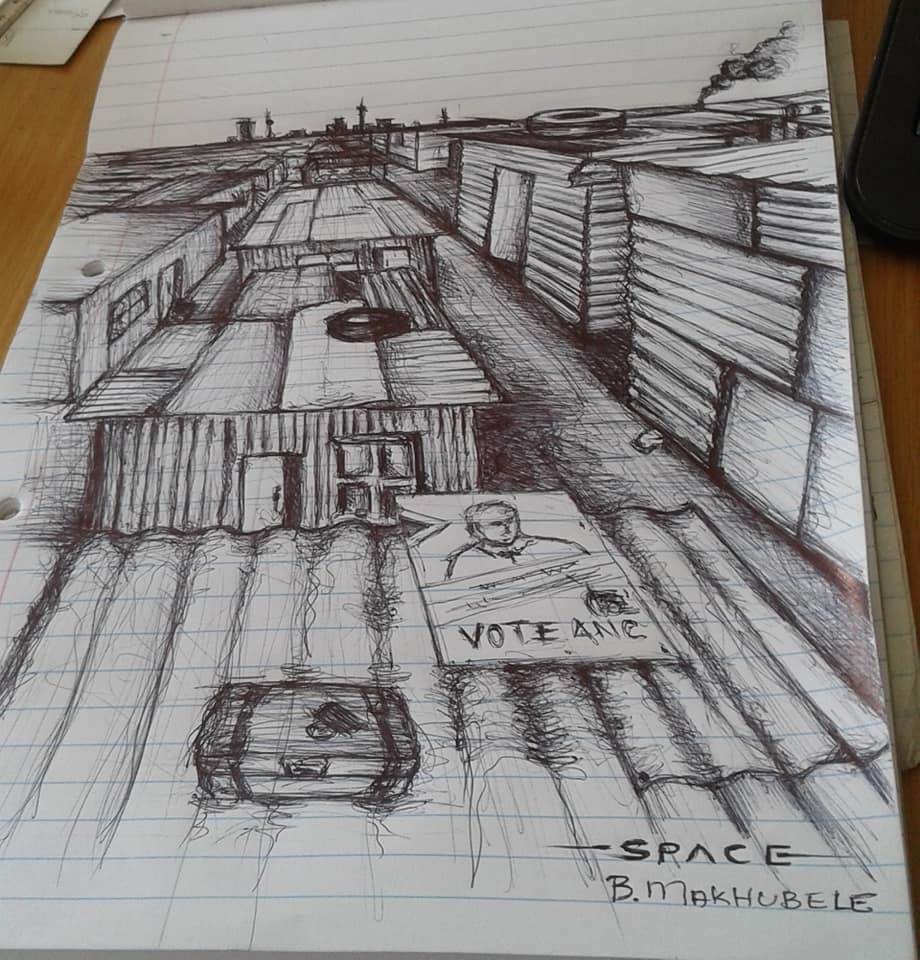
A sketch, titled “SPACE,” is a hauntingly precise exploration of the South African experience—a study of how we live, how we are governed, and the physical distance between promise and reality.
A Vanishing Point of Broken Promises
The first thing that strikes you is the perspective. The artist uses sharp, converging lines to lead the eye down a narrow alleyway of corrugated iron shacks (informal settlements). At the very end of this “street,” looming on the distant horizon, is the silhouette of a modern city skyline, featuring the unmistakable Hillbrow Tower.
The contrast is jarring:
-
The Foreground: Corrugated metal, tires used to hold down roofs, and the claustrophobic density of poverty.
-
The Background: The “Golden City,” a distant dream that feels miles away despite being visible.
The Paper Weight: Politics on the Roof
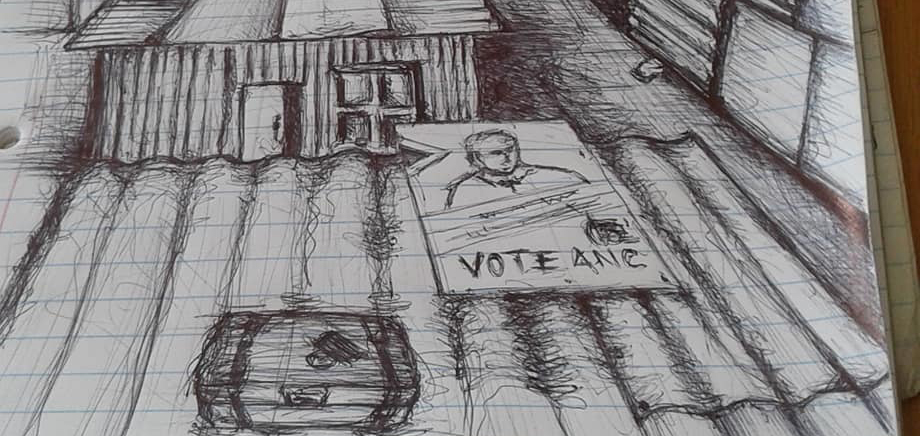
In the center of the frame, weighted down on a corrugated roof, lies a discarded political poster. It reads “VOTE ANC.” There is a biting irony here. In many informal settlements, political posters are repurposed after elections—used as insulation, patches for leaking roofs, or simply left as litter. By placing the poster in the muck of the foreground, Makhubele highlights the disconnect between the high-flying rhetoric of political campaigns and the stagnant daily life of the voters. The “Space” between the ballot box and the kitchen table remains an unbridgeable chasm.
Why “SPACE”?
The title is perhaps the most provocative part of the piece. In a township or informal settlement, “space” is a luxury. People live wall-to-wall, roof-to-roof.
-
Physical Space: The crushing density of the shacks.
-
Economic Space: The gap between the poor foreground and the wealthy background.
-
Mental Space: The aspiration to move from the cramped margins to the open skyline.
The Medium is the Message
Executed in what appears to be simple ballpoint pen on a piece of lined school paper, the medium mirrors the subject. It is resourceful, gritty, and immediate. There are no expensive oils or canvases here—just the tools available to someone with a story that needs to be told now.
Final Thoughts“SPACE” isn’t just a drawing of a township; it’s a map of a social condition. It asks us to look at the parts of our society that we often drive past on the highway. It reminds us that while the skyline represents where we want to be, the foreground is where millions currently are.